

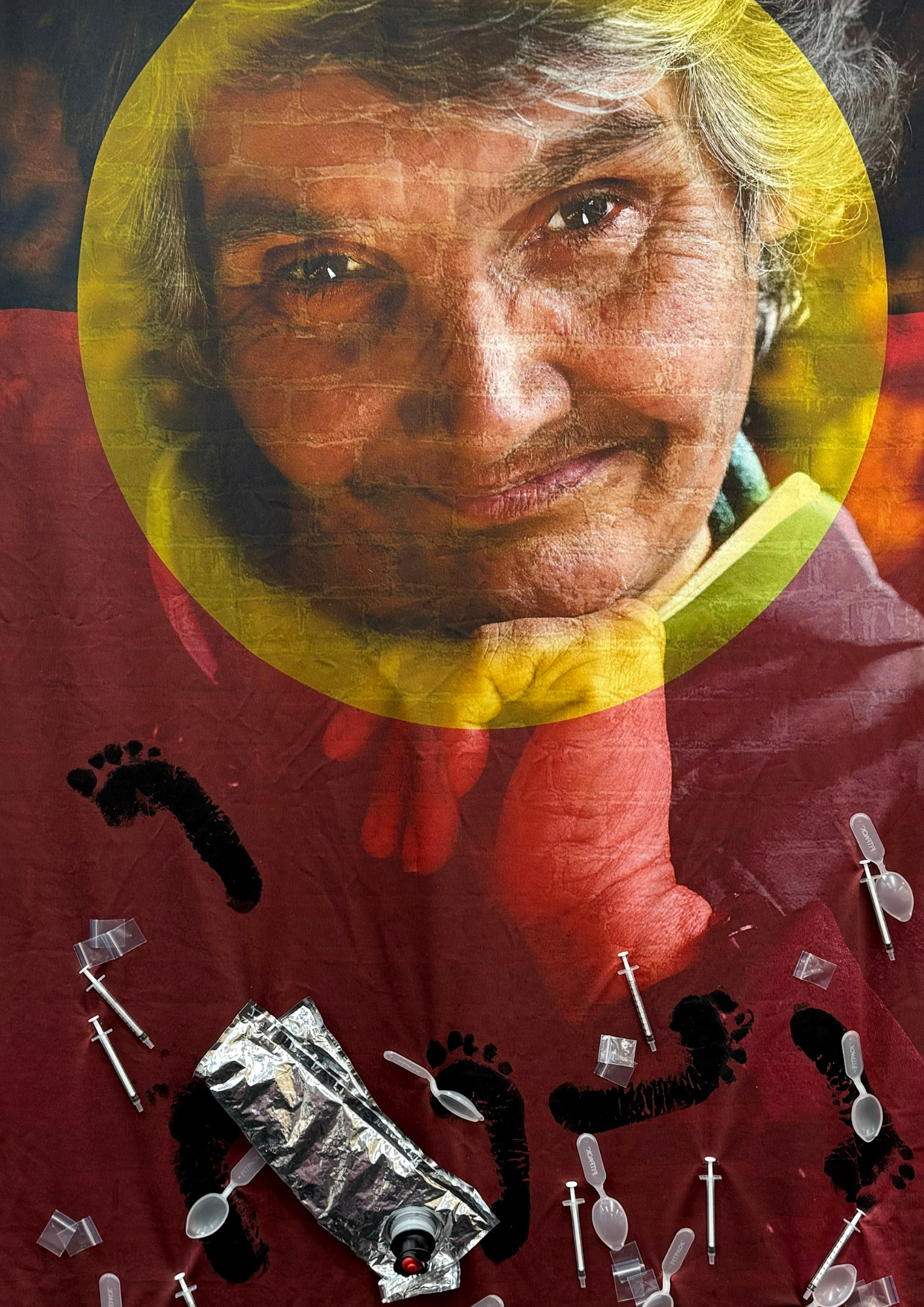
‘I made the flag big ‘cause I am proud to be Aboriginal, proud to know that I’m part of the Aboriginal community. It’s about having a place and belonging. I am a Wailwan and Wiradjuri woman with disability and I was homeless for over thirty years of my life. I am now housed, but after all this time the streeties are still my community. We all come from the same hardship, the hard streets. And they understand me and I understand them. They don’t judge you for what you’ve been through. You can see the goonie, it represents drinking. The needles, spoons and little plastic bags are about drugs. You ask me why I still might take drugs from time to time? Because I know what you see when you look at me. I know what you think, and sometimes that is too much for me. People don’t understand that being homeless, being Aboriginal, being on drugs, being an alcoholic, having mental health. It’s all connected as one, as that barrier…
– Lani
- Title: I’m still here
- Artist: Lani
- Year: 2024
- Medium: Photographic digital print with mixed media
My face coming out of the Aboriginal flag, that’s so people know being Aboriginal is important to me. I want to get my life story out there, because it hits the heart and hurts. But behind my smile is a very broken heart of the broken soul. It won’t ever get fixed. I lost everything once I turned into an adult. The footprints are about my journey in and out of homelessness, which started when I was adopted at the age of five by a white couple. My parents bashed and abused me, and then I found out they never really wanted me. I couldn’t live with it anymore, so I ended up running away from home and ended up in Kings Cross. I was brought up by the streets and started working on the streets and got into the drug scene and mixed with the wrong people. I ended up with very bad depression and anxiety, which I still have to this day.
If you look closely, you can see that there is a faint brick wall over the whole artwork. That is the invisible wall I have built to protect myself from others. But you’ve got to understand if you let people in, sometimes you get hurt. And that’s where I am. I’m at that stage where I don’t let anyone in and I put up that brick wall. When I connect with the so-called normal world, I am judged. But they don’t understand one day it could happen to them. They don’t seem to realise that we don’t make a choice on how we were brought up, how we ended up on the streets and why we ended up on drugs, why we ended up in domestic violence relationships. The judgmental people will always going to be judgmental. No matter what you say to them, they’re going to judge you for whatever reason.
And then I look around and I go, “Well, I have to be a strong Aboriginal person, I’ve got to be strong for everyone around me because the people I have met have given me that strength.” And now I look at it as a miracle that I’m still here.’
– Lani